How to architect a WordPress plugin with free and premium editions
A practical architecture for building a useful free WordPress plugin and upgrade-safe premium extensions without maintaining two conflicting products.
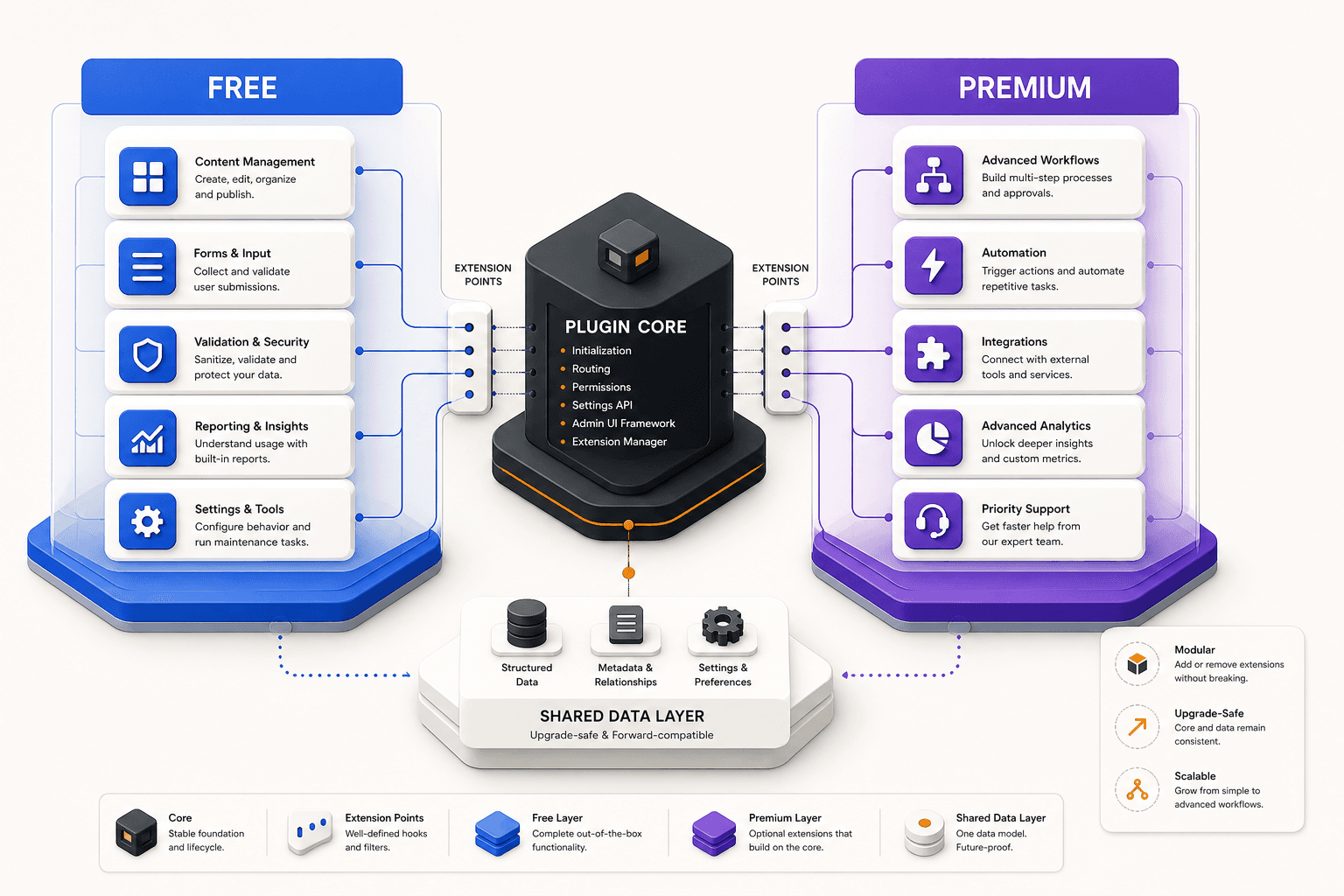
Start with one product promise
A free-and-premium plugin should solve one recognizable problem at both tiers. The free edition proves the core workflow and remains useful on its own. Premium should expand scale, control, automation, integrations, or support; it should not repair an intentionally frustrating free product. This boundary makes positioning clearer and reduces the risk of maintaining two products that drift apart.
Choose the package boundary before writing features
There are two common shapes: a self-contained free plugin with a premium add-on, or separate free and premium packages built from shared internal modules. For a WordPress.org distribution, the add-on model is often easier to reason about because the free plugin remains the stable dependency and premium registers additional services through public hooks or interfaces.
- Keep bootstrapping, permissions, validation, settings contracts, migrations, and shared domain logic in the core.
- Expose narrow actions, filters, interfaces, or service registrations for extensions.
- Place premium-only workflows, integrations, limits, reporting, and update handling in the add-on.
- Fail safely when versions are incompatible; never leave the site in a fatal-error loop.
Make the free edition complete, not merely installable
A useful free tier should complete the primary job end to end for a realistic small use case. Reasonable premium boundaries include higher volume, scheduled automation, advanced rules, team controls, specialized integrations, deeper reporting, and priority support. Avoid disabling basic security, accessibility, data export, or essential recovery controls to create an upgrade incentive.
Treat hooks and data as a public contract
Once premium code or third-party extensions depend on a hook name, option shape, database field, REST response, or capability, that surface becomes part of the product contract. Version it deliberately. Add compatibility layers before renaming or removing it, make migrations repeatable, and test upgrades from supported historical versions rather than testing fresh installs alone.
Keep entitlement checks outside business logic
Scattered license checks make code difficult to test and can accidentally break the free workflow. Resolve entitlement once through a small service, then let features declare the capability they require. Premium being inactive, expired, unavailable, or temporarily unable to reach a licensing service should produce a clear and proportionate state rather than corrupting data or blocking unrelated free features.
Use WordPress security boundaries consistently
Commercial packaging does not change the WordPress security model. Administrative actions still need capability checks and CSRF protection; incoming data needs validation and sanitization; output needs context-appropriate escaping; database work should use supported APIs and prepared queries. If the plugin sends information to an external service, disclose what is sent, why, and under what terms.
Design installation, deactivation, and deletion separately
Activation may establish defaults or run an idempotent migration. Deactivation should normally stop runtime behavior without destroying user data. Permanent cleanup belongs to the uninstall path and should be explicit, documented, and safe for multisite where supported. Users should understand whether deleting the free plugin also affects premium data and whether reinstalling restores the configuration.
Test the edition matrix, not just each plugin alone
The release suite needs clean installs, upgrades, rollbacks, deactivation order, deletion, multisite if supported, and incompatible-version handling. Test the free plugin alone, free plus the current premium add-on, and every supported cross-version combination. Verify that disabling premium leaves free data readable and that an update cannot silently reset entitlement or settings.
- Run static analysis, coding standards, unit tests, integration tests, and representative browser journeys.
- Test valid, invalid, empty, boundary, unauthorized, and concurrent requests.
- Exercise both automatic and manual update paths with a recovery plan.
- Confirm readme, plugin headers, privacy disclosures, changelog, and support documentation match the shipped behavior.
A maintainable commercial boundary
The healthiest architecture is easy to explain: the free plugin owns a dependable core workflow and stable data model; premium registers optional capabilities through documented extension points. That structure supports transparent product decisions, safer updates, clearer testing, and a free edition worth trusting.